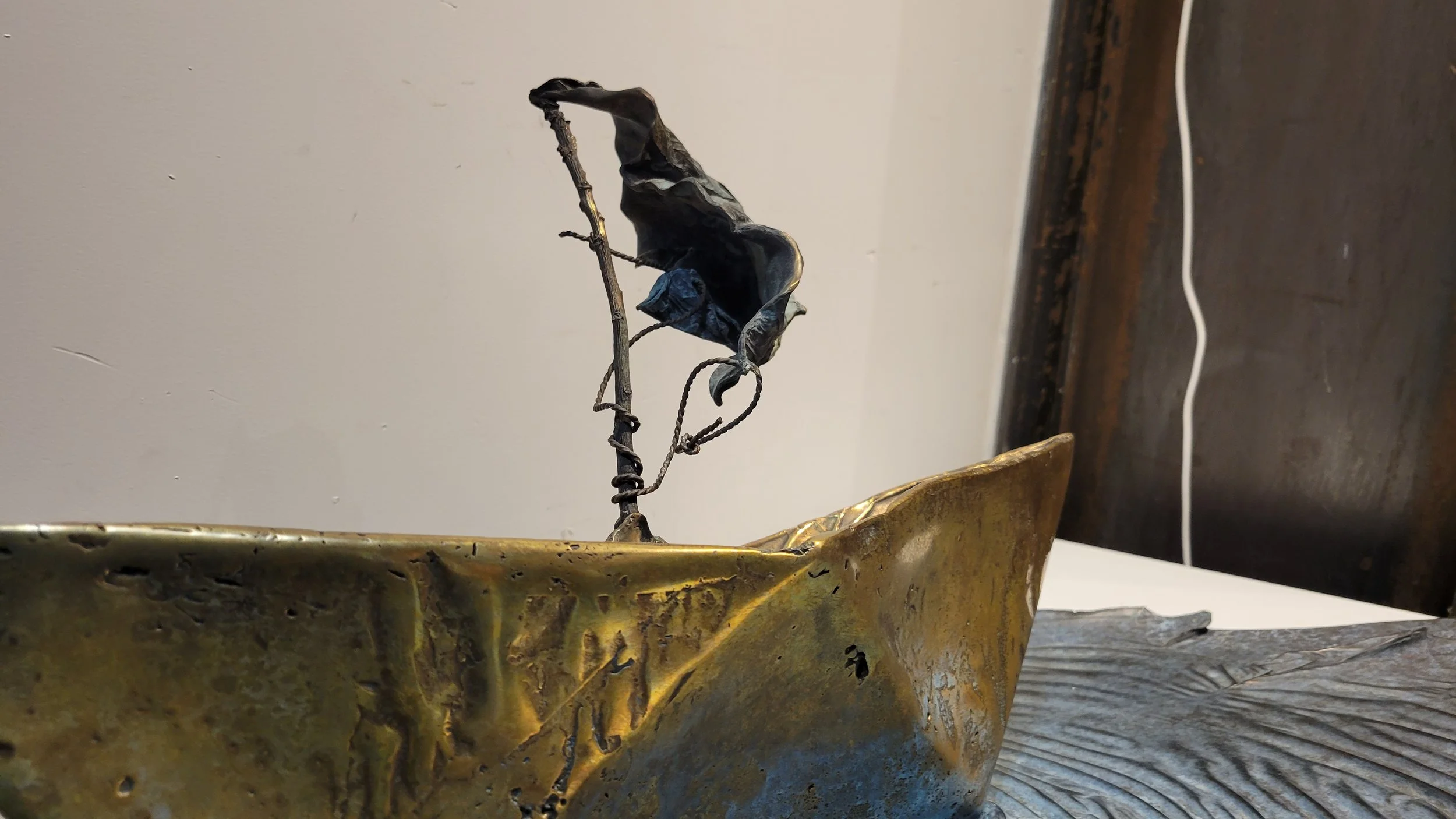
The Boat Remembers
How Polish American Artist Daniel Mariotti Preserves a Fragile Childhood Memory in Bronze
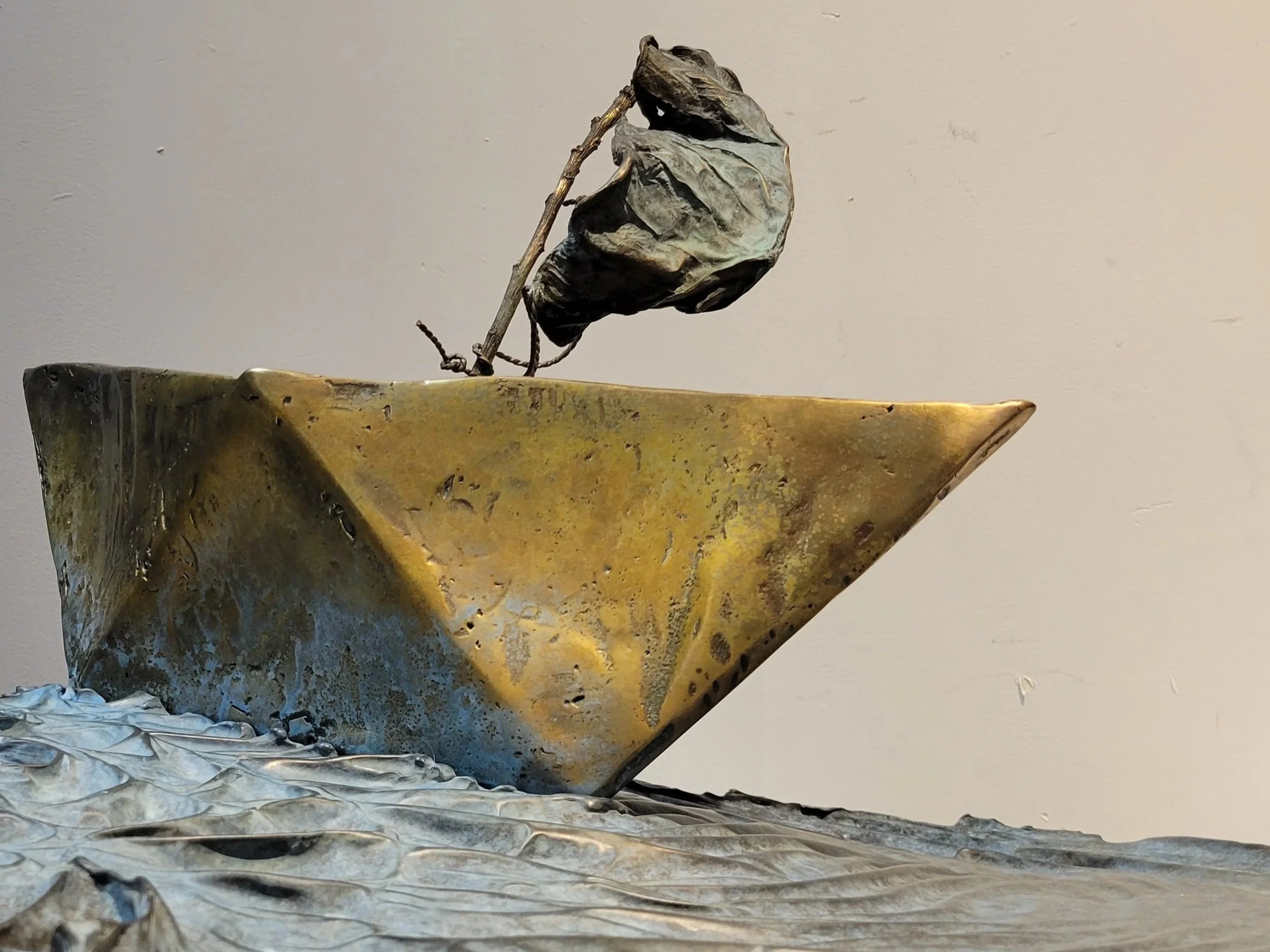
Łódź Pamięta on view during the 2026 Artists to Work Reception and Showcase
Daniel Mariotti was a child, though he did not remember how old, when his father came home with an idea. On a whim, father and son folded papers together to craft the most fragile vessels to ever hit the water. And the water leeched into the hulls so quickly, the two didn’t have the chance to wonder if they should’ve coated or reinforced the paper before it all sank to the depths.
Fragile boats, but an enduring memory. The memory played itself out over and over as Daniel Mariotti continued to fold boats out of restaurant napkins and scrap paper for years. But it played itself out like a record needle scratching the surface of an album that needed to be flipped over–which is to say, folding paper boats was more of a fidget, mindless motion. It wasn’t until Łódź Pamięta (in English, The Boat Remembers) that this moment was memorialized.
Łódź Pamięta takes the origami boat to a new medium, with bronze bringing majesty and permanence to a humble construction. Knowing that Mariotti’s father struggled with Alzheimer’s toward the conclusion of his life animates the work, setting the boat into motion. A distant memory of making paper boats with one’s father who struggled with Alzheimer’s; that memory playing out half-remembered in the hands as a subconscious fidget; that memory culminating in a metal sculpture and enduring legacy–that’s pure literature. I don’t need to write anything more about the message.
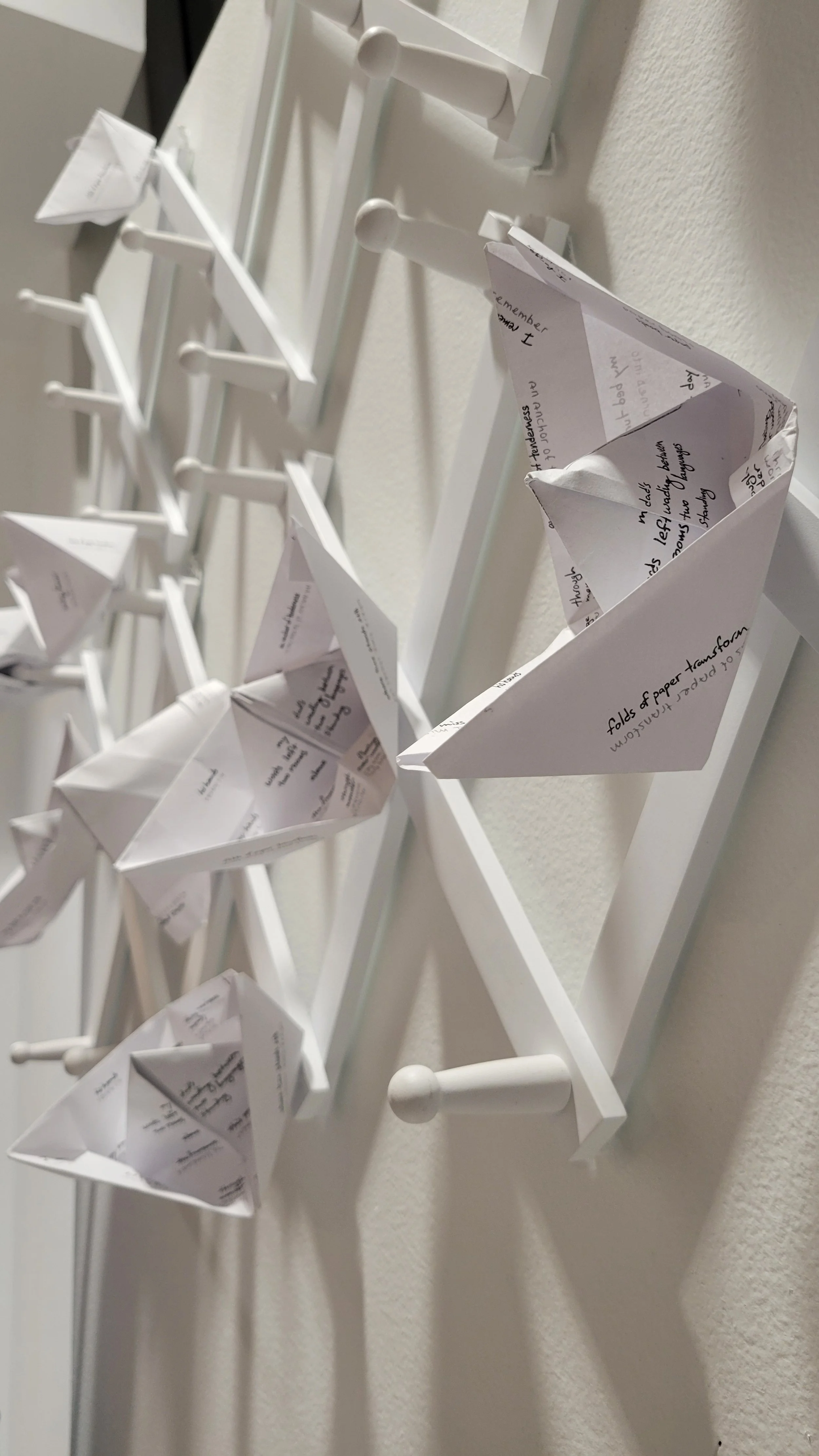
Paper boats folded by visitors leave a wall of community poetry.
Nor does Mariotti. He’s content to have viewers engage with the work instead. He provides a meditative instructional video guiding viewers through the process of folding their own paper boats–something I have never done before. The paper provided comes with prompts. Write who/what you are missing in the center. Flip. Write a moment you hope to hold forever. Outside of the prompt are short phrases, printed in a font Mariotti created to mimic his father’s handwriting. Now we fold. The printed text aligns with all the facets of the hull, making the boat a poem you can read this way and that, as you turn it over in your hands. On the sail, your response to the moment you want to hold on forever. Folded in the lower decks of the boat and no longer visible, who/what you are missing.
I’m keeping my words to myself. The words matter less than the ritual. Once I inscribed the paper, I folded it as neatly as I could while trying to keep pace with the hands in the tutorial video. It would be a lie to claim that I was tender with it, that I reverently built a vessel for my emotions that would embark on a maiden voyage carrying my soul to high, heavenly waters. But I could sit with a cherished memory, work it over with my fingers like a lucky trinket I sometimes forget I carry in my pocket. I take it out just to remember the weight of it, and tuck it away. Brief meditations like that have a cumulative value beyond compare. Łódź Pamięta, in its bronze glory, is the monumental, but my paper imitation in its modesty carries the memory just the same.
When Daniel returned home with his father, they placed paper boats onto the bed, yanking waves into the bedsheets. An afternoon salvaged.
Those who know Daniel know that he admits to little sentiment, telling his stories with aloofness and objectivity. Sitting on his living room floor, I tried to prompt him here and there for poetry. Questions didn’t get me there. But in following his instructions to fold paper boats riddled with poetry and designed with such intentionality, I imagine he latches onto these memories with clenched fists. Or maybe he has to resist that temptation, should his fists crush the boats before they can even make it to the water, or the sheet.